Drug Testing
Drug testing involves an examination of different bodily samples
to detect the presence or absence of illicit substances in the
person who is being examined. Drug tests can also detect traces
of other substances in the system. There are different types of
bodily samples that can be checked when performing drug tests.
These include urine, hair, saliva or oral-based screening, and
a sweat drug testing.
 Drug Testing
 |
|

The first type of testing is a urine screen and is also known
as a urinalysis. This procedure requires the person to provide
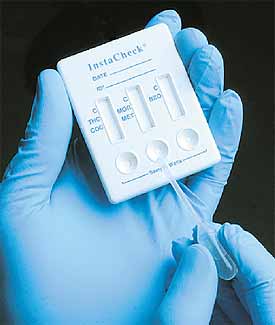
a urine sample. After the sample has been provided, a sample card
may be used on-site to detect results immediately or the sample
may be sent away to have a series of tests performed on it. Some
individuals try to pass screening by drinking a large amount of
water prior to the examine however the sample may be thrown out
if it is too clear, indicating dilution.
Hair tests are another form of common substance screening. Hair
testing is very accurate and results can go back approximately
three months or six months with specialty screening supplies.
The longer the hair, the further back in time one can examine
for potential chemical use. This is due to the fact that as the
hair grows out, the illicit substances used are encased in the
hair shaft.
Some individuals
may try to get out of testing their hair by shaving their heads.
In these cases, body hair can be used although the detection will
be based upon different factors as body hair grows slower than
head hair. The main disadvantage of this type of exam is that
the samples need to be sent to a lab in order to get the results.
This type of screen may not also be able to detect very recent
substance use.
Saliva or oral fluid based drug tests may be used to detect substance
use during the few days prior to the test. This type of screening
is becoming more commonly used due to its convenience and the
fact that it cannot be altered. Oral fluid based testing is also
popular because of the fact that it can be done on-site. Onsite
tests prove to be the most effective type of screening process.
The advantages of this type of testing is that it is donor-friendly,
non invasive and easy to collect the specimen. Oral fluid testing
has a very small time-frame in which substance use can be detected.
Depending on the chemicals used and the person's type of saliva,
this time-frame can be anywhere from a few hour to two or three
days.
The last type of drug testing is the sweat chemical screen. In
this procedure, sweat patches are attached to the skin to collect
perspiration over a prolonged period of time, usually about ten
to fourteen days. This testing is used by child protection services,
parole departments, and other government institutions concerned
with substance abuse over a long period of time.
|
