Employee Drug Testing
Employee drug testing is a major part of a drug-free work environment.
In addition, employee substance abuse testing can save a company
thousands of dollars in sick days, worker's compensation claims
and unemployment benefits. Post-hire employee drug tests are a
good start for insuring a drug-free workplace.
 Employee Drug Testing
|
|

Employers need not stop there, though. Because 77-percent of all
drug abusers are employed, and 65-percent of all workplace accidents
are related to drug abuse, it makes sense for companies to perform
drug testing on current employees as well.
Pre-employment drug testing can only be performed in most states
once a conditional offer for employment has been made.
In order to conduct pre-employment drug testing, the potential
employer needs to:
1. Inform the potential employee during the job interview
of the company's requirement
2. Have the candidate sign and date a permission form for
the drug testing
3. Print the employee drug test requirement in the employee handbook
and in other documents that appear in high-traffic areas in the
workplace
Informing employees upfront about the required pre-employment
and current employment drug testing policy will save companies
many headaches later and will ensure that everyone is on the same
page right from the get-go about the policy.
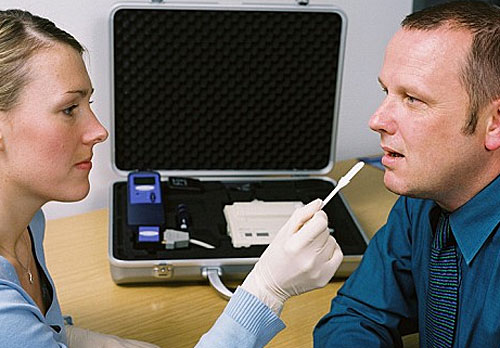
Employee Saliva Drug Test
For those
concerned about employee drug testing versus invasion of privacy
issues there are several items that need to be considered. For
many of the drug tests, direct or indirect observation can be
seen as degrading by those being tested (this is why hair follicle
testing is now becoming popular). If urine screening is being
conducted, the existence of many other physical and medical conditions,
including genetic predisposition to disease - or pregnancy can
be seen as an over-reaching type of invasion of privacy, specifically
being tested for areas that are not related to drug or alcohol
abuse. The ratio of false positive results for labs that have
a hard time distinguishing between legal and illegal substances
for many is unacceptable and can lead to defamation of character
charges.
Some people feel that employee substance testing is invasive
since it mostly punishes what employees do in their off-time in
the privacy of their own homes. Many employees, though agree that
employee drug tests do make sense for safety-sensitive occupations
like airline pilots, air traffic controllers, school bus drivers,
truck drivers, train engineers and others. According to the ACLU,
"Computer-assisted performance tests, which measure hand-eye
coordination and response time, are a better way of detecting
whether employees are up to the job. NASA, for example, has long
used task-performance tests to determine whether astronauts and
pilots are unfit for work - whether the cause is substance abuse,
fatigue, or physical illness."
The ACLU goes onto say that Employee Assistance Programs
(EAP's) are the way for employers to go instead of drug testing.
EAP counselors help employees cope with health, finance, emotional
or substance abuse problems that can affect job performance
and are designed to rehabilitate the employee instead of punish
them.
With 50 million drug tests given to potential employees last
year, the screening for substance abuse problems is not going
away any time soon. Hopefully, employers can come up with
drug-free workplace programs that are meant to screen out
potential problems upfront, rehabilitate the current workers
who need help and do so in a non-invasive manner that protects
the worker, the company and the community at large.
|
