Ecstasy Facts
It was the early to mid 1980's when the drug Ecstasy first really
garnered widespread attention. Back then, when clandestine raves
were all the rage among the teenagers and the early twenties clubbers,
the drug of choice was Ecstasy. Today, this drug is no longer confined
to the rave scene. It's everywhere, from junior high schools to
the violent street gangs.
|
Ecstasy Facts
|
|
Fact 1:
Johns Hopkins University researchers found that after just
4 days of use of the drug, effects were experienced up to
7 years later.
|
|
Fact 2:
From 1996 to 2000, drug enforcement agents saw an increase
in seized ecstasy of over 700-percent.
|
| Fact 3: Drug giant Merck
first patented Ecstasy in 1914. |
| Fact 4: Ecstasy is in
fact methylenedioxymethamphetamine (MDMA) and is considered
by a psychedelic and a stimulant. |
| Fact 5: Many times Ecstasy
is not pure and may be adulterated with additional drugs such
as mescaline, methamphetamine, codeine, dextromethorphan (DXM),
and/or PMA, which in turn can cause overdose and death. |
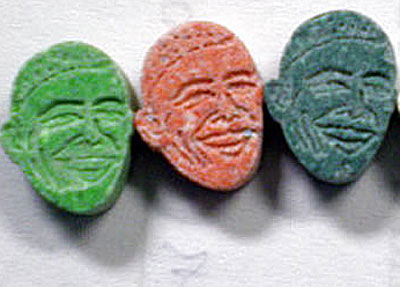
Obama Ecstasy Pills
Known by street names such as XTC and Lover's Speed, Ecstasy
is a chemical synthetically made from the oils of a sassafras
tree. Usually taken in pill form, this drug produces effects that
mimic amphetamines or hallucinogenic drugs, meaning the body is
stimulated and prone to hallucinations. For a quicker high, people
who use this drug have been known to crush it to a powder and
sniff it like cocaine or even inject it.
Ecstasy stimulates the nervous system, making all the nerve
endings more sensitive. This is where the nickname Lover's
Speed comes in. The drug enhances a person's mood, making
them initially feel happy and carefree and tactile. That is
why you might see people who are taking Ecstasy touching each
other a lot.
Within thirty minutes after popping an Ecstasy pill, the
user will start to feel its initial euphoric effects that
can last as long as six hours. Unfortunately, for the user,
there are soon other side effects to Ecstasy that manifest
themselves. Paranoia, problems sleeping, nausea, vision impairment
and symptoms like fever, sweating and chills that some might
liken to influenza can also be experienced.
What is so
scary is that while Ecstasy has these side effects, many habitual
users learn to hide their symptoms and function fairly well in
their everyday lives. Unlike cocaine and other drug addicts, Ecstasy
users hold down jobs and interact with family. By all outward
appearances, they keep up a good façade.
Long-term use of Ecstasy gets more complicated. Users experience
insomnia and other sleep problems. Their memory starts to
suffer and eating habits are not consistent. Sexual dysfunction
happens more often and registering physical pain can become
altered as well. All of this occurs because the serotonin,
a chemical in the brain that regulates most of these processes,
is lost through habitual use of Ecstasy.
Because the drug interferes with each person's body differently,
an overdose on Ecstasy can happen at any time. Death can come
about quickly from a condition called hyperthermia, which
is extreme overheating. Death can also occur from an excessively
stimulated nervous system as well as from drinking too many
fluids. What happens is that since the body cannot control
its temperature, the user quickly overheats. Therefore, some
users overcompensate by drinking too much water, which can
then cause coma from swelling in the brain.
Once pigeon-holed as white suburbia's designer illegal drug,
Ecstasy has reached far beyond the suburbs and into the city and
countryside. It's plentiful and easy to obtain. And, because of
the false sense of euphoria and self-confidence, it can quickly
kill without any advanced notice.
|
